
A pusher centrifuge and a screen scroll centrifuge both separate crystals from liquid through a screen. The main difference is how they move the retained solids: a pusher advances a filter cake with a reciprocating mechanism, while a screen scroll centrifuge uses a screw rotating at a different speed from the basket.
For a slurry that forms a stable, permeable cake, a pusher is a strong candidate when cake washing and drainage time are priorities. A screen scroll centrifuge deserves close evaluation when feed conditions vary and screw conveying must be matched to the separation duty. These are starting points for selection; neither design delivers the lowest moisture or highest recovery in every application.
This guide explains the differences and the information needed to compare an HR pusher with an LWL screen scroll configuration.
Pusher vs. Screen Scroll Centrifuge: Quick Comparison
| Selection factor | Pusher centrifuge | Screen scroll centrifuge |
|---|---|---|
| How solids move | A reciprocating mechanism pushes the cake axially through the basket | A screw conveys solids at a differential speed relative to the basket |
| Cake and feed behavior | Reliable cake formation and drainage are central to selection | Screen, feed distribution and screw geometry must suit the suspension |
| Residence time | Cake transport can provide a relatively long drainage and washing period | Transport and residence time depend on differential speed and geometry |
| Washing | A developed cake provides a route for wash liquid to contact the retained solids | Washing can be incorporated; liquid distribution and contact time need assessment |
| Variable feed | Assess cake stability and liquid loading; pre-thickening or specialized pre-filtration may help | Some designs accommodate fluctuating feed well; confirm the proposed operating range |
| Crystal breakage | Examine feed acceleration, pushing and discharge | Examine feed acceleration, screw contact and discharge |
| Components to compare | Screens, pusher mechanism, hydraulic system and rotating assembly | Screens, scroll wear protection, differential drive and rotating assembly |
The table describes general selection factors, not guaranteed HR or LWL results. Washing, feed flexibility and crystal protection depend on the actual configuration. In particular, specialized pusher pre-filtration systems can broaden the range of feed conditions they handle.
How an HR Pusher Centrifuge Works
A pusher centrifuge retains crystals on a screen while mother liquor passes through it. The cake moves toward the solids outlet in successive pushing strokes and continues to drain during transport.
The HR Horizontal Pusher Centrifuge offered by Echong uses a two-stage arrangement: solids first form a cake in the inner basket, then move into the outer basket for further dewatering before discharge.
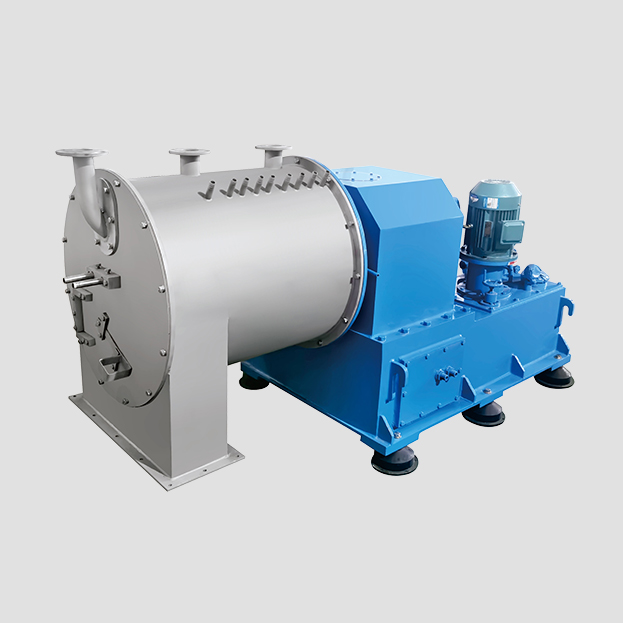
For selection, establish whether the actual slurry forms a cake that drains and moves consistently. Ask how feed concentration changes, fines and washing will affect this behavior. If pre-thickening is proposed, include that equipment and its operating requirements in the comparison.
How an LWL Screen Scroll Centrifuge Works
A screen scroll centrifuge, also called a screen worm centrifuge, filters through a screen and uses a screw to convey the retained solids. The screw and basket rotate at different speeds. Screen geometry, screw design and differential speed influence solids transport and drainage.
The LWL Screen Scroll Centrifuge offered by Echong supports continuous feeding, washing, dewatering and discharge. Drive options should be specified for the proposed model; adjustable differential speed should not be assumed to be included in every quotation.
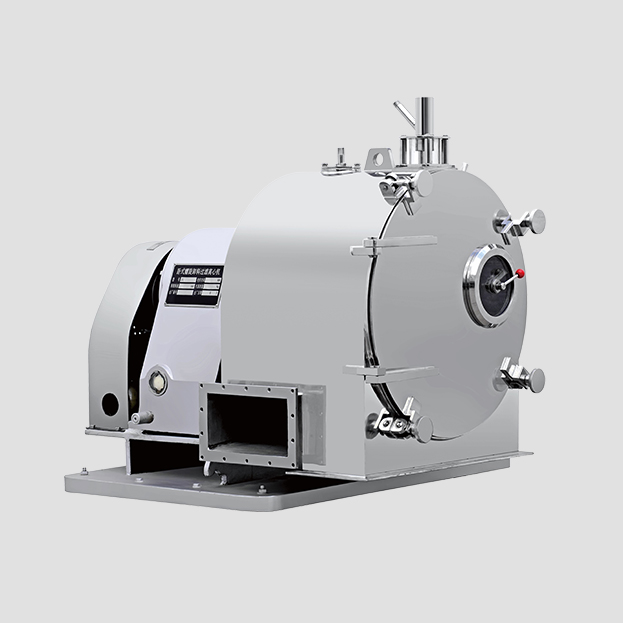
When comparing LWL configurations, ask about the screen opening, screw wear protection, differential-speed arrangement and access for cleaning or replacement. These details are more useful than the machine name alone.
Which Design Should You Evaluate First?
When a pusher is a strong candidate
Start by evaluating a pusher when the slurry can form a stable, permeable cake and the process places a high value on cake washing or effective drainage time. Check how the cake behaves across the expected feed range, including startup and changes in concentration.
A relatively long residence time can support drainage and washing, but it does not automatically produce drier crystals. Particle properties and the liquid retained within the cake also affect the result.
When a screen scroll is a strong candidate
Give a screen scroll close consideration when feed variation is important and the proposed screen, screw and drive arrangement can provide consistent solids transport. Published screen-scroll designs include applications with both high and low feed concentrations. The acceptable range for an LWL machine must be assessed separately.
If crystal size is commercially important, compare samples before and after separation. Screw conveying alone does not establish unacceptable breakage, just as a pusher label does not establish damage-free handling.
When neither should be selected yet
Keep the assessment open if the suspension drains poorly, fails to retain solids effectively or cannot be conveyed reliably. A different filtering configuration, pre-thickening step or another separation technology may be needed. Define the process problem before choosing a model.
Choosing a Centrifuge for Salt Crystals
Sodium chloride
For sodium chloride crystal dewatering, compare residual moisture, purity, solids recovery and the particle-size distribution of the discharged product.
Where crystal washing is required, evaluate how the wash liquid contacts the solids and whether mother liquor and wash filtrate need separate collection. Include dissolution losses in the evaluation. Both equipment families can incorporate washing; the arrangement must be specified.
Potassium chloride
For potassium chloride, include product recovery in the acceptance criteria. Measure solids leaving with the filtrate as well as the discharged product. A low moisture result is less useful if valuable fines are lost to the liquid stream.
The material name alone is not enough to choose between the machines. Particle-size distribution, mother liquor and required product quality remain part of the selection brief.
Ammonium chloride and other crystalline salts
Assess the actual suspension rather than relying only on an application list. Define the feed temperature, mother-liquor composition, corrosion requirements and product targets before requesting a configuration.
For all salt duties, compare quotations using the same feed and acceptance criteria. Slurry flow in m³/h and dry-solids throughput in t/h describe different quantities and should not be treated as interchangeable capacities.
Why Moisture, Fines and Washing Must Be Compared Together
Residual moisture depends on the feed, cake drainage, liquid properties, loading, residence time and washing conditions. A single moisture figure without its test conditions provides an incomplete basis for selection.
Fines require particular attention. They can increase filtration resistance or leave with the filtrate, but they do not automatically exclude a pusher. A developed cake can retain particles that would pass through the screen alone.
A useful comparison records:
- Moisture: the analytical method and sampling conditions.
- Purity: the impurity being removed and the result after washing.
- Recovery: solids in the product, filtrate and other relevant streams.
- Particle quality: changes in the size distribution and fines content.
- Operating duty: slurry flow, dry-solids rate and feed variation.
Use these results together. For example, a washing change may improve purity while increasing moisture or dissolving more product. The preferred operating point is the one that meets the agreed product specification with acceptable recovery and cost.
What Information Is Needed for Equipment Selection?
| Information | What to provide |
|---|---|
| Material | Product name, composition and relevant impurities |
| Capacity | Normal and maximum slurry flow, plus dry-solids throughput if known |
| Feed concentration | Solids content, measurement basis and expected variation |
| Particle properties | Size distribution, shape and sensitivity to breakage |
| Mother liquor | Composition, temperature, viscosity and density where available |
| Product requirements | Target moisture, purity, recovery and particle-size limits |
| Washing | Wash liquid, available flow and impurity-removal objective |
| Installation | Available space, utilities, materials of construction and operating mode |
Unknown values can be identified during the first discussion. Before a detailed proposal, confirm which missing information requires sampling or testing.
Start with your material name, required capacity and target moisture. Email Echong for preliminary centrifuge selection or contact us on WhatsApp.
Comparing Test Results and Operating Costs
A representative sample test can help assess separation feasibility. Continuous conveying behavior and full-scale capacity require an appropriate engineering assessment; a small batch test should not be used as proof of either.
Agree the test conditions in advance and record feed concentration, particle size, liquid temperature, throughput, washing, moisture, purity and solids recovery. Separate measured results from estimates.
When comparing operating costs, include the items affected by the proposed equipment: power, maintenance, wear parts, wash liquid, product losses and downstream drying. Compare the cost of producing material that meets the specification, rather than the purchase price or motor rating alone.
Frequently Asked Questions
Is a pusher centrifuge better than a screen scroll centrifuge for salt?
A pusher is a strong candidate for a permeable, stable cake where washing and drainage time matter. A screen scroll may suit a duty requiring a different solids-conveying arrangement or feed-handling range. The actual slurry and specified configuration determine the final choice.
Which centrifuge produces drier crystals?
There is no universal winner. Compare representative feed at the required throughput and washing conditions, using the same moisture method. Longer drainage time can help some materials, but particle properties and liquid retention can limit the benefit.
Can a screen scroll centrifuge handle changing feed concentration?
Some screen-scroll designs are documented for fluctuating feed and a broad concentration range. Confirm the operating limits of the proposed LWL configuration, including liquid load, solids throughput and drive arrangement.
Does a high fines content rule out a pusher centrifuge?
No. The cake can provide additional particle retention through self-filtration. Evaluate cake permeability, drainage and filtrate solids rather than deciding from the fines percentage alone.
What should I send for an initial recommendation?
Send the material name, required capacity and target product condition. If available, also include solids concentration, particle-size information, feed temperature and washing requirements.
Discuss Your Crystal Dewatering Application
Echong Machine supplies industrial centrifuges for solid-liquid separation and supports equipment screening, technical communication and coordination of material testing where feasible.
Share the separation result you need to improve: moisture, purity, solids recovery or particle quality. We can use that starting point to identify the information needed for an HR or LWL equipment assessment.
Request a centrifuge selection review by email · Discuss your application on WhatsApp